The Mystery Revealed
The Unsearchable Riches of Christ
Scripture: Ephesians 3:7–13
Supporting passages: Ephesians 1:3–14; 2:1–22
Scripture quotations are from the New Living Translation.
Have you ever been given a responsibility that made you wonder why anyone chose you? Perhaps someone asked you to lead a project, teach a class, or accept an assignment that seemed beyond your abilities. You thought, Surely someone else is better qualified.
Kris Kristofferson’s song “Why Me Lord?” gives voice to a similar sense of wonder. Why would God show such kindness to someone who could never earn it?
The apostle Paul understood that question. Before meeting Jesus on the Damascus road, he persecuted Christians and approved of Stephen’s death. Yet Christ called him to proclaim the very gospel he had tried to silence.
The persecutor became a preacher. The enemy of Christ became his servant.
In Ephesians 3, Paul reflects on that calling. What amazes him is both the grace that reached him and the message God entrusted to him:
“Though I am the least deserving of all God’s people, he graciously gave me the privilege of telling the Gentiles about the endless treasures available to them in Christ.”
—Ephesians 3:8
Paul’s words reveal an unworthy servant, an inexhaustible message, and an extraordinary purpose.
1. An Unworthy Servant
The Incredible Grace of God’s Calling
Paul explains how he became a servant of the gospel:
“By God’s grace and mighty power, I have been given the privilege of serving him by spreading this Good News.”
—Ephesians 3:7
Paul had considerable education and ability, but he does not present those qualifications as the reason God called him. He points instead to God’s grace and power.
Then he describes himself as “the least deserving of all God’s people.” His wording intensifies the idea of being least. We might express it as “the least of the least.”
This was no display of false humility. Paul remembered the believers he had persecuted. He remembered Stephen. He knew that if God’s calling depended on human merit, his past would stand against him.
Grace begins with the goodness of God.
God took a persecutor and made him a preacher. He entrusted a man who had tried to destroy the church with the responsibility of helping build it.
That should encourage us. Sometimes we see only our failures, weaknesses, age, or limited resources. We remember what we wish we had done differently and conclude that God probably has little use for us now.
Paul’s story reminds us that our past does not place us beyond the reach of God’s grace. Our present circumstances do not exhaust his ability to work through us.
God’s grace is greater than our failures, and his power is greater than our weaknesses. Paul’s calling rested in the gracious character of God.
So does our hope.
2. An Inexhaustible Message
The Riches of Christ
Paul calls his message “the endless treasures available to them in Christ.” Other translations describe these treasures as “the unsearchable riches of Christ.”
The expression suggests riches that cannot be fully traced out or explored.
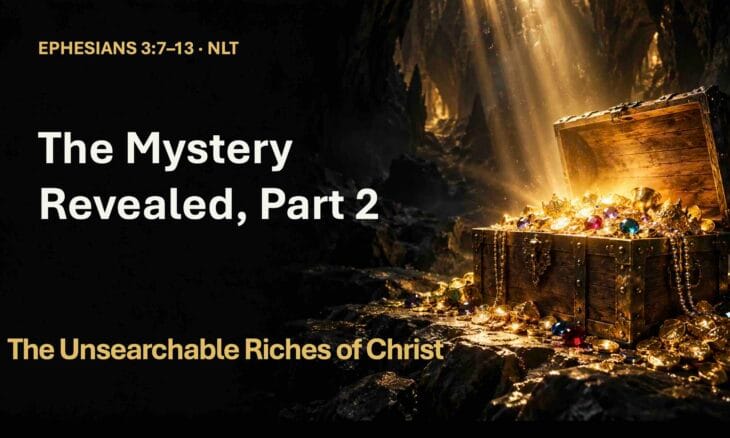
Imagine an explorer entering a cavern filled with treasure. The first chamber contains more gold and precious stones than he has ever seen. Then he notices a passage leading to another chamber, larger than the first. Beyond that lies another, and another.
Every discovery reveals more to explore. Eventually, he realizes that he will never reach the end.
That is the picture Paul gives us of the riches of Christ. He has already spent two chapters describing God’s blessings, yet there is still more to discover.
The Treasure Chest That Has No Bottom
Suppose we gathered the blessings described in Ephesians into one enormous treasure chest. What would we find as we began taking them out?
Grace. God loved us when we were spiritually dead. He did not wait for us to become good enough. By his grace, he made us alive with Christ.
Forgiveness. Through the blood of Jesus Christ, God offers forgiveness for our sins. Our failures and rebellion do not place us beyond his mercy.
Redemption. In Christ, we find release from sin’s bondage. Our past no longer has the final word over our future.
Adoption. God welcomes us into his family. He calls us his children and makes us members of his household.
Peace. Christ brings us peace with God and with one another. Through his cross, he breaks down the walls that divide us.
Hope. God gives us a confident expectation rooted in his promises. Our hope rests in his faithfulness.
Power. The mighty power that raised Jesus Christ from the dead is at work in those who believe.
The Holy Spirit. God dwells within his people. His Spirit marks us as his own and guarantees our inheritance.
Purpose. We are God’s workmanship, created anew in Christ Jesus for the good works he prepared for us. Our lives have meaning in his service.
Love. Christ’s love is so wide, long, high, and deep that it surpasses our ability to comprehend it fully.
Eternal life. Our relationship with God does not end at the grave.
Just when we think we have reached the bottom of the chest, we discover that there is no bottom.
Every blessing leads us into a deeper understanding of the grace, mercy, wisdom, and love of Jesus Christ.
We can discover his riches, but we can never exhaust them.
Treasures for the Nations
Paul’s calling was to announce these riches to the Gentiles: the peoples beyond Israel who had once been strangers to God’s promises.
Through Christ, people of every language, culture, and ethnic background are invited to share in God’s blessings. These riches belong to everyone who belongs to Christ.
God’s purpose also reaches beyond individual blessing. He brings people from different nations together into one body.
That leads us to the third movement of this passage.
3. An Extraordinary Purpose
The Wisdom of God Displayed
Paul writes:
“God’s purpose in all this was to use the church to display his wisdom in its rich variety to all the unseen rulers and authorities in the heavenly places. This was his eternal plan, which he carried out through Christ Jesus our Lord.”
—Ephesians 3:10–11
God uses the church to display his wisdom, even to the unseen rulers and authorities in the heavenly places.
Who are these rulers and authorities?
Elsewhere in Ephesians, Paul uses similar language for spiritual powers beyond the visible world. Ephesians 1:20–21 describes Christ’s exaltation above every ruler and authority. Ephesians 6:12 identifies hostile spiritual powers as enemies in our spiritual struggle.
Here in chapter 3, Paul does not explicitly settle whether he means hostile powers specifically or heavenly beings more broadly. His central point, however, is clear: God’s work through the church has significance beyond what we can see.
We often measure a congregation by attendance, finances, or programs. Paul asks us to consider something far greater. When God reconciles people to himself and brings them together in Christ, the heavenly powers witness his wisdom.
Through Christ’s death and resurrection, God accomplishes what we could never accomplish for ourselves. He overcomes sin and breaks down the barriers that divide us, creating one new humanity in Christ.
He displays this wisdom through ordinary people whose lives his grace has transformed.
One Lord, One Family
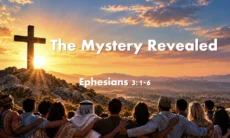
At FMBC, we share our campus with Christians from different nations, languages, and cultures. Our songs, foods, and traditions may differ, but we belong to the same Lord Jesus Christ.
Because we belong to Christ, we belong to one another.
Our differences do not have to disappear for us to become one in him. They provide opportunities for God’s wisdom to become visible as we learn to love, serve, and pray for one another.
When people who once stood apart worship and work together in Jesus’ name, the world sees the reconciling power of the gospel. According to Paul, even the heavenly powers witness God’s wisdom through the church.
This was God’s eternal purpose, accomplished through Jesus Christ. We now have the privilege of participating in it.
Our significance rests in the greatness of the God whose purposes we serve. What happens here on earth matters in heaven.
The Messenger in Chains
Paul closes this part of his letter with a remarkable request:
“So please don’t lose heart because of my trials here. I am suffering for you, so you should feel honored.”
—Ephesians 3:13
The man entrusted with announcing Christ’s inexhaustible riches was a prisoner. His assignment reached to the nations, but his own movements were restricted.
Yet Paul urged the Ephesians not to lose heart.
They could imprison the messenger, but they could not imprison the message.
Chains could restrict Paul’s movements, but they could not restrict the love of Christ. Prison walls could confine his body, but they could not lock away the riches of God’s grace.
That message continued to spread. Across centuries, it has crossed oceans and boundaries of language and culture. Today, it has reached us.
We have received the grace Paul proclaimed, experienced the forgiveness he announced, and entered the family he described. We, too, belong to the church through which God displays his wisdom.
The Mission Entrusted to Us
What will we do with the riches we have received?
Paul understood that Christ’s riches were a message to proclaim. God entrusted him with good news for the nations, and he has entrusted that same good news to us.
We may not have Paul’s education, opportunities, or influence. But we know what God’s grace has done for us, and we know that his grace is available to our neighbors.
That includes neighbors who speak English, Spanish, Arabic, Amharic, Burmese, Zomi, and many other languages. Each is a person God loves. Each needs the riches available through faith in Jesus Christ.
FMBC, we can trust God with our future. Our age, finances, and attendance do not define the limits of his power. The God who called an unlikely messenger named Paul still works through unlikely people.
There is more grace than we can exhaust, more mercy than we can measure, and more love than we can comprehend. We will never finish discovering the riches of Christ.
The treasure chest has no bottom. The invitation reaches every nation. And the privilege of sharing those riches now belongs to us.
May God give us the grace to be faithful messengers of his inexhaustible riches. Amen.