
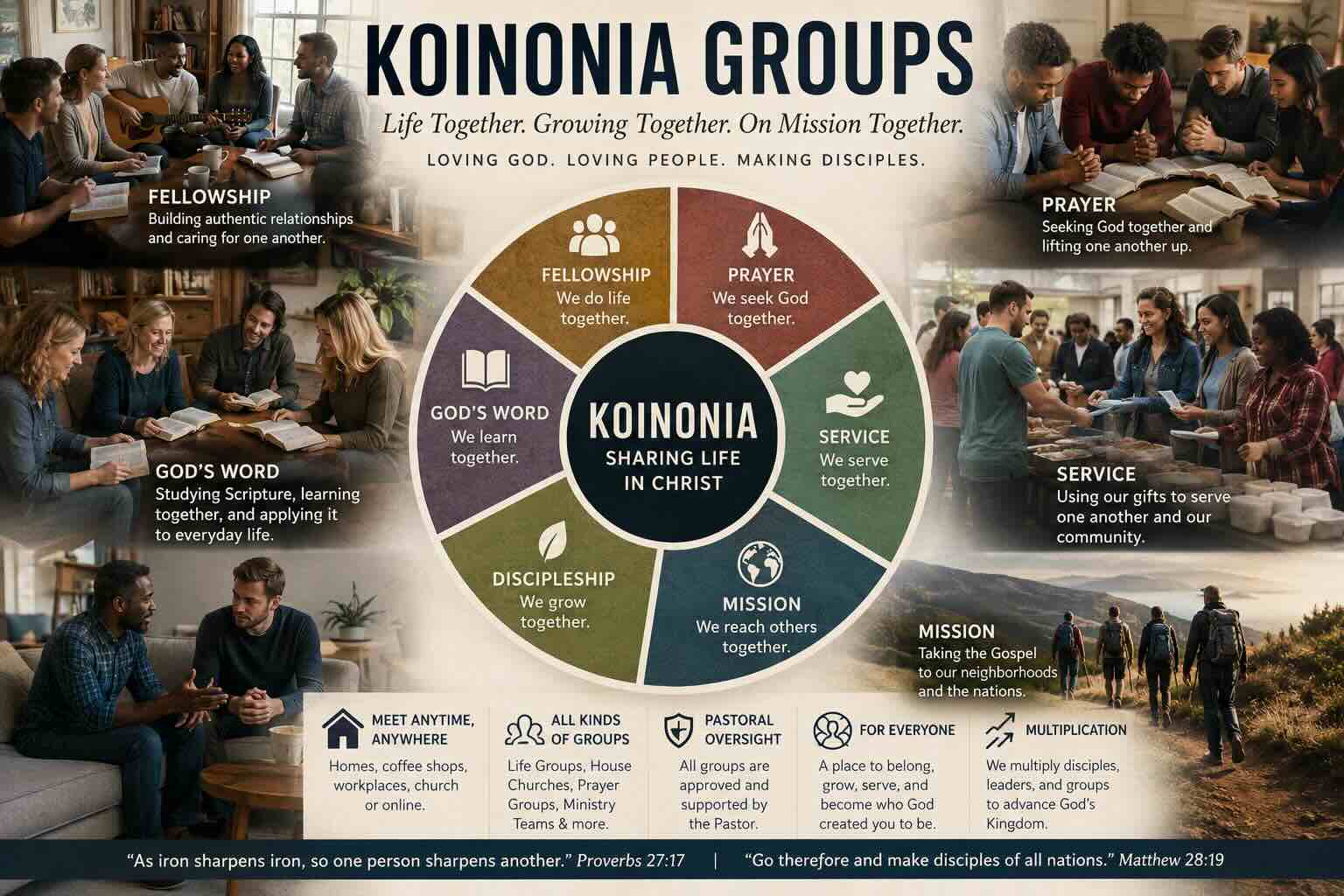
Koinonia Groups: Doing Life Together
At Forest Meadow Baptist Church, we believe the Christian life was never meant to be lived alone. God calls His people into a spiritual family where believers worship together, pray together, learn together, serve together, and help one another follow Jesus faithfully.
What is a Koinonia Group?
Throughout the New Testament, followers of Jesus met not only in large public gatherings, but also in homes, small fellowships, ministry teams, and discipleship communities. These smaller gatherings became the relational heartbeat of the early church.
At Forest Meadow, we call these gatherings Koinonia Groups.
Depending on their purpose and setting, and specific methodology, they may also be called:
- Life Groups
- House Churches
- Home Groups
- Discipleship Groups
- Prayer Groups
- Fellowship Groups
- Ministry Teams
- Mission Teams
- Bible Study Groups
- ESL/ Life Skills Groups
- Language specific Groups
No matter the name, the purpose remains the same—to put into practice the principles of: Loving God. Loving People. Following Jesus.
What Does the word “Koinonia” Mean?
The Greek New Testament word koinonia refers to sharing life together:
- Fellowship— living life together in union with Jesus Christ and other believers
- Sharing–our common faith, resources and love for one another
- Participation–no “lone wolf” Christianity, but taking part in the community of believers
- Partnership— forging agreements that move us all closer to the Kingdom of God
- Common life together— we may not have the same heart language or cultural background. We may even have doctrinal differences on non-essential issues. But we share a common commitment to the Bible, to Jesus Christ, summed up in:
Loving God. Loving others. Following Jesus.
Koinonia means believers sharing life together under the Lordship of Jesus Christ.
Koinonia is much deeper than casual friendship or social activity. Koinonia means believers sharing life together under the Lordship of Jesus Christ. The life of a believer includes:
- Worshiping only God— “The Scriptures say, ‘You must worship the Lord your God and serve only him.” Luke 4:8
- Prayer—“I also tell you this: If two of you agree here on earth concerning anything you ask, my Father in heaven will do it for you. 20 For where two or three gather together as my followers, I am there among them.” Matthew 18:19-20
- Encouragement— For God chose to save us through our Lord Jesus Christ, not to pour out his anger on us. 10 Christ died for us so that, whether we are dead or alive when he returns, we can live with him forever. 11 So encourage each other and build each other up, just as you are already doing.” 1 Thessalonians 5:9-11
- Accountability–“Dear brothers and sisters, if another believer is overcome by some sin, you who are godly should gently and humbly help that person back onto the right path. And be careful not to fall into the same temptation yourself. 2 Share each other’s burdens, and in this way obey the law of Christ.” Galatians 6:1-2
- Hospitality—“8 Most important of all, continue to show deep love for each other, for love covers a multitude of sins. 9 Cheerfully share your home with those who need a meal or a place to stay. 1 Peter 4:8-9
- Discipleship–“28 So we tell others about Christ, warning everyone and teaching everyone with all the wisdom God has given us. We want to present them to God, perfect in their relationship to Christ. 29 That’s why I work and struggle so hard, depending on Christ’s mighty power that works within me.”
- Generosity–“18 Tell them to use their money to do good. They should be rich in good works and generous to those in need, always being ready to share with others. 19 By doing this they will be storing up their treasure as a good foundation for the future so that they may experience true life.” 1 Timothy 6:18-19
- Mission—8 But you will receive power when the Holy Spirit comes upon you. And you will be my witnesses, telling people about me everywhere—in Jerusalem, throughout Judea, in Samaria, and to the ends of the earth. Acts 1:8
- Spiritual Growth–“14 Then we will no longer be immature like children. We won’t be tossed and blown about by every wind of new teaching. We will not be influenced when people try to trick us with lies so clever they sound like the truth. 15 Instead, we will speak the truth in love, growing in every way more and more like Christ, who is the head of his body, the church. 16 He makes the whole body fit together perfectly. As each part does its own special work, it helps the other parts grow, so that the whole body is healthy and growing and full of love. Ephesians 4:14-16
What Do Koinonia Groups Do?
Christian fellowship is not simply attending the same church service. It is not the artificial practice that many churches still do, where at the beginning of the worship service, the worship leader challenges everyone to get up and wander around the worship center looking for people to shake hands with. It is more significant than that–it is learning to do life together as the family of God.
The Bible illustrates this pattern. In Acts 2:42-47, it says, “42 All the believers devoted themselves to the apostles’ teaching, and to fellowship, and to sharing in meals (including the Lord’s Supper), and to prayer.
43 A deep sense of awe came over them all, and the apostles performed many miraculous signs and wonders. 44 And all the believers met together in one place and shared everything they had. 45 They sold their property and possessions and shared the money with those in need. 46 They worshiped together at the Temple each day, met in homes for the Lord’s Supper, and shared their meals with great joy and generosity—47 all the while praising God and enjoying the goodwill of all the people. And each day the Lord added to their fellowship those who were being saved.”
Koinonia Groups participate in an almost unlimited number of different activities as they live life together :

- Sharing a meal
- Praying together
- Bible study
- Discussing Sunday’s sermon
- Encouraging one another
- Helping with practical needs
- Celebrating birthdays, milestones, and holidays
- Caring for people during sickness, grief, or crisis
- Language-based groups
- Men’s/Women’s groups
- Youth and young adult groups
- Senior adult groups
- New believer groups
Whatever believers do in Koinonia, it focuses their group on one of three things:
1. Loving God
- Koinonia groups help us worship God in daily life.
- We learn to pray, listen to Scripture, and encourage one another to obey Jesus.
- We grow spiritually as we walk together.
2. Loving People
- Koinonia groups create space for real caring.
- People are noticed.
- Needs are shared.
- Burdens are carried together.
- Different cultures are honored.
3. Making Disciples
- Fellowship groups are not just social gatherings.
- They help people follow Jesus.
- They provide a simple place to ask questions, grow in faith, and practice obedience.
- New believers can be encouraged and mentored.
Additional Key passages:
- 1 John 1:3-4 We proclaim to you what we ourselves have actually seen and heard so that you may have fellowship with us. And our fellowship is with the Father and with his Son, Jesus Christ. 4 We are writing these things so that you may fully share our joy.”
- Philippians 1:4-5 Whenever I pray, I make my requests for all of you with joy, 5 for you have been my partners in spreading the Good News about Christ from the time you first heard it until now.
- Hebrews 10:24–25 “Let us think of ways to motivate one another to acts of love and good works. 25 And let us not neglect our meeting together, as some people do, but encourage one another, especially now that the day of his return is drawing near.
The New Testament Pattern of Koinonia Groups

The early church regularly gathered for koinonia in homes as well as larger public settings.
The New Testament describes believers:
- meeting in homes
- praying together
- studying the apostles’ teaching
- sharing meals
- caring for one another
- discipling new believers
- worshipping together
- serving together in mission
Key passages:
- Acts 2:42–47—See above
- Acts 5:42–42 And every day, in the Temple and from house to house, they continued to teach and preach this message: “Jesus is the Messiah
- Romans 16:5–5 Also give my greetings to the church that meets in their home.
- Colossians 4:15–15 Please give my greetings to our brothers and sisters at Laodicea, and to Nympha and the church that meets in her house.
- Philemon 1-2–I am writing to Philemon, our beloved co-worker, 2 and to our sister Apphia, and to our fellow soldier Archippus, and to the church that meets in your house.
The church was not merely a building people attended once a week. It was a living spiritual community. In many parts of the world today, it is still the primary meeting place of a church.
Large worship gatherings were important as well, but it turns out that spiritual growth happens bets in homes and smaller communities where people could truly know and encourage one another. One writer says that the church is like a two-winged bird, where one wing is large group and the other wing is small groups. Like a bird, for a church to be healthy it needs both of its wings—small group ministry and large group ministry– to be equally strong.
Why Do Koinonia Groups Matter?
Spiritual Growth Happens best in Small Groups.
People grow spiritually through:
- encouragement
- accountability
- prayer
- shared experiences
- practical obedience
- learning together
Large worship services are important for:
- preaching
- corporate worship
- vision
- celebration
But smaller groups create space for:
- conversation
- questions
- mentoring
- confession
- encouragement
- accountability
- personal care
- practice of agape-action oriented love
Key passages:
- Ephesians 4:11–16– 11 Now these are the gifts Christ gave to the church: the apostles, the prophets, the evangelists, and the pastors and teachers. 12 Their responsibility is to equip God’s people to do his work and build up the church, the body of Christ. 13 This will continue until we all come to such unity in our faith and knowledge of God’s Son that we will be mature in the Lord, measuring up to the full and complete standard of Christ.
14 Then we will no longer be immature like children. We won’t be tossed and blown about by every wind of new teaching. We will not be influenced when people try to trick us with lies so clever they sound like the truth. 15 Instead, we will speak the truth in love, growing in every way more and more like Christ, who is the head of his body, the church. 16 He makes the whole body fit together perfectly. As each part does its own special work, it helps the other parts grow, so that the whole body is healthy and growing and full of love. - Hebrews 3:13-14–You must warn each other every day, while it is still “today,” so that none of you will be deceived by sin and hardened against God. 14 For if we are faithful to the end, trusting God just as firmly as when we first believed, we will share in all that belongs to Christ.
- Galatians 6:1–2–Dear brothers and sisters, if another believer is overcome by some sin, you who are godly should gently and humbly help that person back onto the right path. And be careful not to fall into the same temptation yourself. 2 Share each other’s burdens, and in this way obey the law of Christ.
- James 5:16–Confess your sins to each other and pray for each other so that you may be healed. The earnest prayer of a righteous person has great power and produces wonderful results.
- Proverbs 27:17–“As iron sharpens iron, so a friend sharpens a friend.”
Small Groups Help Believers Practice the “One Another” Commands
The New Testament contains many commands that cannot be fully practiced in isolation or anonymity.
Believers are called to:
- love one another
- pray for one another
- bear one another’s burdens
- encourage one another
- forgive one another
- teach one another
- serve one another
- show hospitality to one another
These commands are best lived out in close Christian community.
Key passages:
- John 13:34–35–So now I am giving you a new commandment: Love each other. Just as I have loved you, you should love each other. 35 Your love for one another will prove to the world that you are my disciples.”
- Romans 12:10–Love each other with genuine affection, and take delight in honoring each other.
- Galatians 6:2—See above
- Colossians 3:16–Let the message about Christ, in all its richness, fill your lives. Teach and counsel each other with all the wisdom he gives. Sing psalms and hymns and spiritual songs to God with thankful hearts.
- 1 Peter 4:8–10–8 Most important of all, continue to show deep love for each other, for love covers a multitude of sins. 9 Cheerfully share your home with those who need a meal or a place to stay. 10 God has given each of you a gift from his great variety of spiritual gifts. Use them well to serve one another.[1]
Small Groups and Discipleship
Jesus did not merely gather crowds. He made disciples. To be sure, he preached to large crowds as he created opportunities together. But out of the multitudes, he called groups of three, twelve, seventy-two, and more. The smaller the group, the more intense was the discipleship.
He taught:
- publicly
- personally
- relationally
- through shared life
- through mentoring
- through obedience-based learning
He invested deeply in smaller groups of disciples who would later multiply His mission throughout the world.
Key passages:
- Matthew 28:18–20–18 Jesus came and told his disciples, “I have been given all authority in heaven and on earth. 19 Therefore, go and make disciples of all the nations, baptizing them in the name of the Father and the Son and the Holy Spirit. 20 Teach these new disciples to obey all the commands I have given you. And be sure of this: I am with you always, even to the end of the age.”
- Mark 3:13–15–13 Afterward Jesus went up on a mountain and called out the ones he wanted to go with him. And they came to him. 14 Then he appointed twelve of them and called them his apostles. They were to accompany him, and he would send them out to preach, 15 giving them authority to cast out demons.
- Luke 6:12–13–12 One day soon afterward Jesus went up on a mountain to pray, and he prayed to God all night. 13 At daybreak he called together all of his disciples and chose twelve of them to be apostles.
- 2 Timothy 2:2–2 You have heard me teach things that have been confirmed by many reliable witnesses. Now teach these truths to other trustworthy people who will be able to pass them on to others.
- Mark 5:37 –“Then Jesus stopped the crowd and wouldn’t let anyone go with him except Peter, James, and John (the brother of James).”
- Matthew 17:1– “Six days later Jesus took Peter and the two brothers, James and John, and led them up a high mountain to be alone.”
- Mark 14:33–“He took Peter, James, and John with him, and he became deeply troubled and distressed.”
- Luke 10:1–“The Lord now chose seventy-two other disciples and sent them ahead in pairs to all the towns and places he planned to visit.”
- Luke 10:17–“When the seventy-two disciples returned, they joyfully reported to him, ‘Lord, even the demons obey us when we use your name!’”
At Forest Meadow, we believe discipleship must move beyond information alone. Biblical discipleship involves:
- Learning everything that Jesus taught
- Obedience to what he commands
- Transformation of our lives so that we reflect the character and actions of Jesus
- Mission—to make disciples of every people group with which we come in contact
- Multiplication of disciples who make disciples. . .
Zúme and Multiplying Discipleship
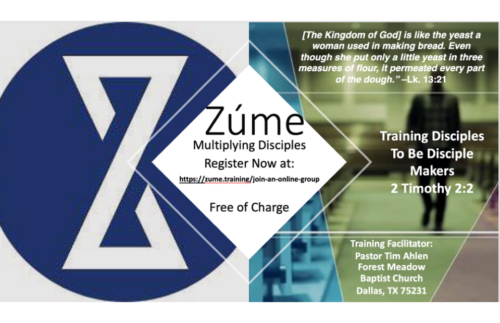
Our foundational discipleship pathway to carry out God’s mission is based on the principles taught through Zúme Training. Zúme is an online and in person discipleship process that features the following:
- Free Registration gives you full access to all training materials and online coaching.
- Instructional Videos help your group understand basic principles of multiplying disciples.
- Group Discussions help your group think through what is being shared.
- Simple Exercises help your group put what you are learning into practice.
- Session Challenges help your group keep learning and growing between sessions.
Zúme teaches that discipleship is for every ordinary believer. It teaches thirty-two principles and skills that you need for becoming a fully mature disciple of Jesus, including:
- obedience-based discipleship, not simply a catalogue of spiritual information
- prayer—how to pray biblically and effectively
- Scripture discovery- how an ordinary believer can read and understand the Bible for themselves
- Accountability- how to give and receive encouragement from fellow believers
- simple reproducible ministry- how to pass on what you learn to others in simple ways that they can easily begin to use in their lives
- evangelism—how to introduce unbelievers to Jesus Christ
- disciple multiplication–how to train disciples who make disciples
- leadership development—how to lead your own small group
- church multiplication as a natural “next step” after disciple multiplication
So, rather than creating passive spectators, the goal is to help every believer become:
- a disciple
- a disciple-maker
- a servant
- a witness
- a spiritual encourager
- a faithful follower of Jesus
We desire for every member of our church family to participate in multiplying discipleship relationships.
Different Types of Koinonia Groups
Not every group will look exactly the same.
Some groups may focus more heavily one purpose than another. Here are some of the purposes of small groups at FMBC:
- Bible study—to study God’s Word in practical understandable ways that lead into spiritual maturity
- Prayer—Learning how to pray but then to join with others in actually praying for the things God lays on your heart
- Fellowship—Relationships are a primary need for healthy disciples and participation in a fellowship group fosters strong Christian relationships
- Outreach (aka Evangelism) groups focus on activities that spread the Good News of Jesus Christ to people who have not yet accepted Jesus as Lord.
- Ministry groups focus on providing for various needs experienced by fellow believers, friends and neighbors
- Zúme training groups focus on raising up disciplemakers through the Zúme training process.
- Pastoral care groups provide pastoral counseling and support to church members and neighbors
- Missions groups focus on cross cultural ministry and outreach, giving special attention to unreached people groups.
- Cultural fellowship groups are formed by members of specific cultures to reach out and provide community to the people of their birth culture.
Some may meet:
- weekly
- biweekly
- monthly
- seasonally
- for short periods of time
Some may gather:
- In traditional church buildings
- in homes
- online
- in coffee shops
- in workplaces
- in restaurants
- in community settings
Some groups may be language-based or culturally connected while still remaining united within the larger church family.
This flexibility reflects the diversity of the Body of Christ.
Key passages:
- 1 Corinthians 12:12–27—12 The human body has many parts, but the many parts make up one whole body. So it is with the body of Christ. 13 Some of us are Jews, some are Gentiles, some are slaves, and some are free. But we have all been baptized into one body by one Spirit, and we all share the same Spirit.
14 Yes, the body has many different parts, not just one part. 15 If the foot says, “I am not a part of the body because I am not a hand,” that does not make it any less a part of the body. 16 And if the ear says, “I am not part of the body because I am not an eye,” would that make it any less a part of the body? 17 If the whole body were an eye, how would you hear? Or if your whole body were an ear, how would you smell anything?
18 But our bodies have many parts, and God has put each part just where he wants it. 19 How strange a body would be if it had only one part! 20 Yes, there are many parts, but only one body. 21 The eye can never say to the hand, “I don’t need you.” The head can’t say to the feet, “I don’t need you.” 22 In fact, some parts of the body that seem weakest and least important are actually the most necessary. 23 And the parts we regard as less honorable are those we clothe with the greatest care. So we carefully protect those parts that should not be seen, 24 while the more honorable parts do not require this special care. So God has put the body together such that extra honor and care are given to those parts that have less dignity. 25 This makes for harmony among the members, so that all the members care for each other. 26 If one part suffers, all the parts suffer with it, and if one part is honored, all the parts are glad.27 All of you together are Christ’s body, and each of you is a part of it. - Revelation 7:9-10—9 After this I saw a vast crowd, too great to count, from every nation and tribe and people and language, standing in front of the throne and before the Lamb. They were clothed in white robes and held palm branches in their hands. 10 And they were shouting with a great roar,
“Salvation comes from our God who sits on the throne and from the Lamb!” - Ephesians 2:11–22— 11 Don’t forget that you Gentiles used to be outsiders. You were called “uncircumcised heathens” by the Jews, who were proud of their circumcision, even though it affected only their bodies and not their hearts. 12 In those days you were living apart from Christ. You were excluded from citizenship among the people of Israel, and you did not know the covenant promises God had made to them. You lived in this world without God and without hope. 13 But now you have been united with Christ Jesus. Once you were far away from God, but now you have been brought near to him through the blood of Christ.
14 For Christ himself has brought peace to us. He united Jews and Gentiles into one people when, in his own body on the cross, he broke down the wall of hostility that separated us. 15 He did this by ending the system of law with its commandments and regulations. He made peace between Jews and Gentiles by creating in himself one new people from the two groups. 16 Together as one body, Christ reconciled both groups to God by means of his death on the cross, and our hostility toward each other was put to death.
17 He brought this Good News of peace to you Gentiles who were far away from him, and peace to the Jews who were near. 18 Now all of us can come to the Father through the same Holy Spirit because of what Christ has done for us.
19 So now you Gentiles are no longer strangers and foreigners. You are citizens along with all of God’s holy people. You are members of God’s family. 20 Together, we are his house, built on the foundation of the apostles and the prophets. And the cornerstone is Christ Jesus himself. 21 We are carefully joined together in him, becoming a holy temple for the Lord. 22 Through him you Gentiles are also being made part of this dwelling where God lives by his Spirit.
House Churches and Ministry Teams
We often confuse form with function. In other words, some might consider it unspiritual to use musical instruments to accompany the musical part of their worship. Or, that an organ is acceptable but a keyboard or piano is not. Or, that a church building (usually with a steeple) is the only suitable form of building in which believers are to worship. If you look closely at the Bible you will see that it does not mandate the form of building to worship in or the kind of instruments to use to accompany your worship. Instead the Bible always stresses the function of these things. Whatever you do in your church, no matter where you meet or what, if any, instruments you use, they should always facilitate
- Loving God
- Loving Others
- Following Jesus
When it comes to Koinonia Groups, some may function much like New Testament house churches, even though they meet in homes or public spaces or warehouses or coffee shops. Whatever their meeting place may be, Koinonia meetings will function as communities that:
- worship together
- pray together
- share meals
- minister together
- serve their communities together
In more general terms, Koinonia groups function as ministry teams focused on:
- prayer
- evangelism
- benevolence
- discipleship
- worship
- missions
- youth ministry
- children’s ministry
- community outreach
In every case, the goal is not to conform to a particular form, but to fulfill a particular function. Koinonia groups do not seek independence from the church, but deeper participation in the mission of the church.
Pastoral Oversight and Unity
At Forest Meadow Baptist Church, all Koinonia Groups operate under pastoral oversight and spiritual accountability.
Groups may meet at any time during the week, but they must be approved by the appropriate Pastor, or the United Nations Ministry Team, made up of the pastors of the Forest Meadow partner congregations.
This kind of accountability helps preserve unity and doctrinal integrity:
- Essential doctrinal unity
- spiritual health
- accountability
- healthy leadership
- mission alignment
- protection for members
- connection to the larger church family
The goal is not fragmentation into disconnected groups, but multiplication within unity.
Key passages:
- Acts 20:28-30– 28 “So guard yourselves and God’s people. Feed and shepherd God’s flock—his church, purchased with his own blood—over which the Holy Spirit has appointed you as leaders. 29 I know that false teachers, like vicious wolves, will come in among you after I leave, not sparing the flock. 30 Even some men from your own group will rise up and distort the truth in order to draw a following.
- Hebrews 13:17–17 Obey your spiritual leaders, and do what they say. Their work is to watch over your souls, and they are accountable to God. Give them reason to do this with joy and not with sorrow. That would certainly not be for your benefit.
- Titus 1:5–9– 5 I left you on the island of Crete so you could complete our work there and appoint elders in each town as I instructed you. 6 An elder must live a blameless life. He must be faithful to his wife, and his children must be believers who don’t have a reputation for being wild or rebellious. 7 A church leader is a manager of God’s household, so he must live a blameless life. He must not be arrogant or quick-tempered; he must not be a heavy drinker, violent, or dishonest with money. 8 Rather, he must enjoy having guests in his home, and he must love what is good. He must live wisely and be just. He must live a devout and disciplined life. 9 He must have a strong belief in the trustworthy message he was taught; then he will be able to encourage others with wholesome teaching and show those who oppose it where they are wrong.
- 1 Peter 5:1–5–And now, a word to you who are elders in the churches. I, too, am an elder and a witness to the sufferings of Christ. And I, too, will share in his glory when he is revealed to the whole world. As a fellow elder, I appeal to you: 2 Care for the flock that God has entrusted to you. Watch over it willingly, not grudgingly—not for what you will get out of it, but because you are eager to serve God. 3 Don’t lord it over the people assigned to your care, but lead them by your own good example. 4 And when the Great Shepherd appears, you will receive a crown of never-ending glory and honor. 5 In the same way, you who are younger must accept the authority of the elders. And all of you, dress yourselves in humility as you relate to one another, for
“God opposes the proud but gives grace to the humble.”
A Church Family on Mission
Another way to look at Koinonia groups is to be about the mission of the church to multiply. Koinonia Groups are not meant to become closed circles focused only on themselves.
The early church continually sought to grow bigger by multiplying their groups. We see the early church:
- welcome new people
- share the gospel
- care for the needy
- make disciples
- plant churches
- cross cultural boundaries
- carry the message of Jesus to the unreached peoples
Healthy small groups should always look outward as well as inward.
Key passages:
- Matthew 28:18–20-– 18 Jesus came and told his disciples, “I have been given all authority in heaven and on earth. 19 Therefore, go and make disciples of all the nations, baptizing them in the name of the Father and the Son and the Holy Spirit. 20 Teach these new disciples to obey all the commands I have given you. And be sure of this: I am with you always, even to the end of the age.”
- Acts 1:8— 8 But you will receive power when the Holy Spirit comes upon you. And you will be my witnesses, telling people about me everywhere—in Jerusalem, throughout Judea, in Samaria, and to the ends of the earth.”
- Acts 13:1–3—Among the prophets and teachers of the church at Antioch of Syria were Barnabas, Simeon (called “the black man”), Lucius (from Cyrene), Manaen (the childhood companion of King Herod Antipas), and Saul. 2 One day as these men were worshiping the Lord and fasting, the Holy Spirit said, “Appoint Barnabas and Saul for the special work to which I have called them.” 3 So after more fasting and prayer, the men laid their hands on them and sent them on their way.
- Romans 15:20–22–20 My ambition has always been to preach the Good News where the name of Christ has never been heard, rather than where a church has already been started by someone else. 21 I have been following the plan spoken of in the Scriptures, where it says,
“Those who have never been told about him will see,
and those who have never heard of him will understand.”
22 In fact, my visit to you has been delayed so long because I have been preaching in these places.
- 2 Timothy 2:2—Timothy, my dear son, be strong through the grace that God gives you in Christ Jesus. 2 You have heard me teach things that have been confirmed by many reliable witnesses. Now teach these truths to other trustworthy people who will be able to pass them on to others.“
Everyone Has a Place
In any event, everyone has a place in one of the churches at Forest Meadow. Some people connect best in large worship gatherings. Others grow best through smaller relational communities.
In healthy churches, both are needed.
Our Invitation to you is this:
If you would like to achieve any of these spiritual milestones :
- grow spiritually
- build meaningful Christian friendships
- study the Bible with others
- learn to make disciples
- serve others
- pray with other believers
- participate in the Mission
- become part of a spiritual family
…we invite you to become part of a Koinonia Group.
Together, by God’s grace, we seek to:
Love God. Love People. Make Disciples.
Who Can Join?
- Church members
- Visitors
- New believers
- Families
- Singles
- Seniors
- Immigrants and refugees
- People still exploring faith
What to Expect
- Warm welcome
- Simple Bible discussion
- Prayer
- Friendship
- Respect for different backgrounds, cultures and languages
- No pressure to speak if you are not ready
Invitation
If you are interested, you can:
- Join a group– either a new or existing one
- Start a group– if you have an interest that is compatible with the church’s mission but we don’t have a group focusing on that interest yet
- Host a group– if you are already a member or have a group of people you would like to mentor or lead
- Help lead a group– a wise choice if you are new to the concept of Koinonias
- Invite a friend– to help expand youe existing group
Call to Action Buttons:
- To find a Fellowship Group or to start a group, by ask your congregation’s pastor. Pastor Tim is always available to guide you to the right group. You can contact Tim at timahlen@me.com
- Contact Us. If you have any other question go to this link. You will likely find just the right person to help.