Text: Ephesians 3:1–6
Sermon Series: God’s Masterpiece — The Letter to the Ephesians
Central Truth: God’s eternal purpose, now revealed through Jesus Christ, is to bring people who were once divided into one family, sharing equally in his promises.
Sermon Objective: To help us understand that unity among believers from different ethnic, cultural, and linguistic backgrounds is not simply a good idea. It is part of God’s eternal purpose, accomplished through Jesus Christ.
Supporting Scriptures: Genesis 12:1–3; Isaiah 49:6; Acts 10:34–35; Galatians 3:26–29; Ephesians 2:11–22.
Prepared length: Approximately 17 minutes.
Introduction: The Mystery Hidden in Plain Sight
Have you ever watched a good mystery movie? The story usually begins with something that doesn’t make sense. There are clues scattered throughout the movie, but you don’t know how they fit together. You see the clues. You hear the conversations. You watch the events unfold. But you don’t understand what is really happening. Then, near the end of the movie, something is revealed. Suddenly, everything makes sense!
You remember something that happened at the beginning of the story, and you realize it was important all along. The clues were there. But you didn’t understand what they meant until the mystery was revealed. Something like that happened in the story of God. For centuries, God had been revealing his purposes through the people of Israel. He called out to Abraham and promised to bless him. He promised that Abraham’s descendants would become a great nation.
But God also told Abraham something remarkable:
“All the families on earth will be blessed through you.” (Genesis 12:3, NLT)
Did you hear that? All the families on earth! Not just Abraham’s descendants. Not just the nation of Israel. All the families of the earth. Centuries later, God spoke through the prophet Isaiah about his servant, who would bring salvation to the nations:
“I will make you a light to the Gentiles, and you will bring my salvation to the ends of the earth.” (Isaiah 49:6, NLT)
The clues were there. Promises made. God had promised that his salvation would reach the nations. But there was something about God’s plan that had not yet been fully revealed. The people of Israel knew that God had chosen them. They knew God had promised a Messiah. They knew that someday the nations would experience God’s blessing. But the one thing they did not understand—they did not fully understand that God intended to create one new people, bringing believing Jews and believing Gentiles together as equal members of one body through Jesus Christ.
That was the mystery. And in Ephesians 3, Paul tells us that the mystery has finally been revealed. Last week, we saw that Jesus Christ has broken down the dividing wall of hostility between Jews and Gentiles. Through his death on the cross, he has made peace between people who were once separated. He has created one new humanity. Now Paul, in Ephesians 3:1–6, explains that this was not an unexpected development in God’s plan. It was God’s purpose all along.
And Paul wants us to understand three things about that mystery.
He tells us that in B.C., before Christ, there was a mystery concealing God’s plan.
I. The Mystery Concealed
God’s Plan Was Always Bigger Than Israel
Ephesians 3:1–2, 5a
Paul begins chapter 3 with these words:
“When I think of all this, I, Paul, a prisoner of Christ Jesus for the benefit of you Gentiles…” (Ephesians 3:1, NLT)
And then Paul does something interesting. He begins a sentence, but before he finishes it, he stops to explain something. He interrupts himself! He riffs on the idea of the Mystery of the Gospel that God revealed. He doesn’t return to his original thought until verse 14. Now, some of us know what that’s like! But Paul’s interruption is not simply a digression. He wants his readers to understand something important about God’s plan and his own ministry.
Notice how he describes himself. He calls himself a prisoner of Christ Jesus. Not a prisoner of Rome. A prisoner of Christ Jesus! He had been arrested, not because of any crime, but because of his ministry. His imprisonment was connected to his work among the Gentiles. Paul understood that even in his imprisonment he was tightly chained to his calling to serve Christ. Then, in verse 2, he refers to the special responsibility God gave him to extend his grace to the Gentiles—to invite the Ethne to become part of the family.
The Greek word Paul uses is οἰκονομία. It means stewardship or administration—the responsibility of managing something that belongs to someone else. Paul did not invent the gospel. He did not decide on his own that Gentiles should be included in God’s family. God entrusted Paul with the responsibility of announcing what God had already determined to accomplish. And what God intended to accomplish was much bigger than anyone had imagined. Think about God’s promise to Abraham.
God chose Abraham and his descendants for a special purpose. But that purpose was never simply to bless Abraham’s family. God intended to bless all the nations—panta ta ethne—through Abraham’s family. Israel was chosen to become a channel of God’s blessing to the world. And through the centuries, God continued to reveal that purpose. The prophets spoke of a coming Messiah. They spoke of a day when all the ethne would come to know the Lord.
But the full nature of God’s plan remained hidden. They did not yet see how God would bring Jews and Gentiles together into one new humanity through Jesus Christ.
Application
Sometimes we make the mistake of thinking that God’s purposes begin and end with us. We think about what God is doing in our lives, our families, and our church. And those things matter. But God’s purposes are always bigger than our immediate circumstances. We can become so concerned about the future of our congregation that we forget the larger mission God has given us.
God’s purpose for us is to make his love and grace known among the people he has placed around us. And those people come from many nations, speak many languages, and represent many cultures. The question is not whether those people fit into our plans. The question is whether our plans fit into God’s purposes. That’s the first thing Paul wants us to understand. God’s plan was always bigger than one nation, one culture, or one people. But its full meaning remained concealed until the coming of Christ. That brings us to my second point.
II. The Mystery Revealed (Part 1)
God Has Made His Purpose Known Through Jesus Christ
Ephesians 3:3–5
Listen to what Paul says in verse 3:
“As I briefly wrote earlier, God himself revealed his mysterious plan to me.” (Ephesians 3:3, NLT)
The Greek word translated “mystery” is μυστήριον. When we hear the word mystery, we usually think of something that cannot be explained. But that’s not what Paul means. In Paul’s writings, a mystery is something that was previously hidden but has now been revealed by God. It is not a puzzle that human beings can solve if they are clever enough. It is a truth that can only be known because God chooses to reveal it.
Paul says: “The mystery was made known to me by revelation.” And Paul was not the only one. In verse 5, he says:
“God did not reveal it to previous generations, but now by his Spirit he has revealed it to his holy apostles and prophets.” (NLT)
There are three things I want you to notice. First, Paul speaks about previous generations. God had revealed much about his redemptive purposes through the Old Testament prophets. But they had not understood the full nature of the new community God would create through Christ. Second, Paul says, “But now.” Those two words mark a turning point in God’s great story of salvation. Something has happened that changes everything.
Jesus Christ has come. He has died for our sins. He has risen from the dead. And through him, God has opened the way for people from every nation to become members of his family. Third, Paul says that God revealed this mystery by his Spirit. The Holy Spirit disclosed God’s purposes to the apostles and prophets of the early church. They came to understand what God had accomplished through Jesus Christ.
Peter Learns the Meaning of the Mystery
Remember what happened to Peter in Acts 10. Peter was a faithful Jewish believer. He knew that Jesus was the Messiah. But he still struggled to understand the full implications of the gospel for Gentiles. Then God sent him to the home of Cornelius, a Roman centurion. Cornelius was a Gentile. And under the religious and social customs Peter had inherited, entering a Gentile home was something he ordinarily avoided.
But God had been preparing Peter.
And when Peter arrived, he made a remarkable statement:
“I see very clearly that God shows no favoritism.” (Acts 10:34, NLT)
Peter was beginning to understand the mystery. The gospel was not simply for people who shared his Jewish heritage. It was for everyone. And when the Holy Spirit came upon the Gentiles gathered in Cornelius’s house, Peter could no longer deny what God was doing. God had welcomed them. Who was Peter to exclude them?
Application
There is an important lesson here for us today. Sometimes our traditions, experiences, and cultural assumptions make it difficult for us to recognize what God is doing. Peter had to learn that God’s purposes were greater than the boundaries he had inherited. And sometimes we need to learn the same lesson. We may be comfortable worshiping with people who speak our language, share our customs, and understand our traditions.
But God has never promised to limit his family to people who are comfortable with one another. The gospel does not require people to become like us before they can belong to Christ. It calls all of us to become like Jesus. And that brings us to the heart of Paul’s message. Point No. 3.
III. The Mystery Revealed (Part 2)
God Has Made Us One Family in Christ
Ephesians 3:6
Now we come to the most important verse in our text. Paul finally tells us exactly what the mystery is. He writes:
“And this is God’s plan: Both Gentiles and Jews who believe the Good News share equally in the riches inherited by God’s children.” (Ephesians 3:6, NLT, excerpt)
Paul uses three remarkable words to describe what God has accomplished. These three words explain the mystery.
A. We Are Fellow Heirs—Together with One Another
The first word means that Gentiles share the same inheritance as Jewish believers. Think about what that means. Paul says that through Jesus Christ, those who were once outsiders have become full members of God’s family. They share the inheritance. They are not second-class members. They do not receive a smaller portion because of their ancestry. They are fellow heirs. Paul makes the same point in Galatians 3:29:
“And now that you belong to Christ, you are the true children of Abraham. You are his heirs, and God’s promise to Abraham belongs to you.” (NLT)
Our inheritance is determined by our spiritual relationship to Christ, not by our fleshly ancestry.
B. We Are Members Together in the Same Body
The second word is particularly important. It means that Jewish and Gentile believers belong to the same body. Not two bodies. Not separate religious communities with different standing before God. One body. Remember what Paul said in Ephesians 2:15. Christ created one new humanity from the two groups. Now Paul takes that truth a step further. We are not merely individuals who happen to share the same religious beliefs.
We belong to one another. Each of us has an essential but small part to play in the life of our people. But small and insignificant as we may feel sometimes, because we are many, we are a part of something so much bigger than just ourselves. And that something is the Body of Jesus Christ! This is a much deeper kind of unity than simply agreeing to get along.
Think about your physical body. Your hands, feet, eyes, and ears are different. They perform different functions. But they belong to one body. And the body needs all of them. The same is true of the church. We come from different backgrounds. We speak different languages. We have different customs. We may even have different ways of expressing our worship. But in Christ, we belong to one big body.
Our differences do not have to disappear for our unity to become real. Our unity is grounded in Christ.
C. We Are Fellow Participants Together in the Promise
The third word means that Gentile believers share equally in God’s promise through Jesus Christ. Notice the progression. We share the same inheritance. We belong to the same body. And we participate in the same promise. What promise? Ultimately, the promise of God’s salvation and all the blessings that come through Jesus Christ. The promise God made to Abraham has reached its fulfillment in Christ. And everyone who belongs to Christ shares in that promise.
There is no separate gospel for different ethne. There is no black gospel. No white gospel. No African or European or American gospel. No rich or poor. No prosperity gospel or suffering gospel. There is no special entrance requirement based on ethnicity, language, or culture. There is one Savior. One gospel. One promise. And one family of God. And if you believe what I’m saying, if you trust God to be true, the Promise of the Gospel—No more guilt, no more shame, no more fear, no more loneliness—forgiveness of sins and eternal life are all yours along with all the other believing Jews and Gentiles. We are ONE!
What Does This Mean for Forest Meadow?
I want you to think about the people who gather for worship on this campus. Some worship in English. Others worship in Spanish, Amharic, Zomi, Burmese, Arabic, or other languages. Our congregations have different histories. We have different traditions. We sing different songs. Some of us have lived in Dallas most of our lives. Others have traveled halfway around the world to make Dallas their home.
But if we belong to Jesus Christ, we are members of the same body. Now, we need to be careful here. Sharing a campus does not automatically mean that we are experiencing the kind of unity Paul describes. Paul is describing something much greater than sharing facilities. He is describing a new humanity created by Jesus Christ. And that raises some important questions. We asked some of these last week.
Do we see the other congregations as partners in God’s mission? Do we recognize their gifts and contributions to the body of Christ? Are we willing to learn from them? Are we willing to pray with them, serve with them, and share in their joys and struggles? Or do we simply think of them as other groups that happen to meet in our buildings? And we need to compete with them to be the “biggest and best?”
God has not merely placed different congregations on the same campus. He has given us an opportunity to demonstrate what it means to live out the mystery by being one body in Christ. And we must not overlook the final words of verse 6. Paul says all of this happens:
ἐν Χριστῷ Ἰησοῦ διὰ τοῦ εὐαγγελίου
“In Christ Jesus through the gospel.”
Our unity is not something we manufacture through human effort. It is not achieved merely by encouraging people to be more tolerant. It is not the result of a successful multicultural program. It is something God accomplishes in Jesus Christ through the gospel. The gospel does not make everyone culturally identical. It makes us one in Christ.
Conclusion: Living the Mystery
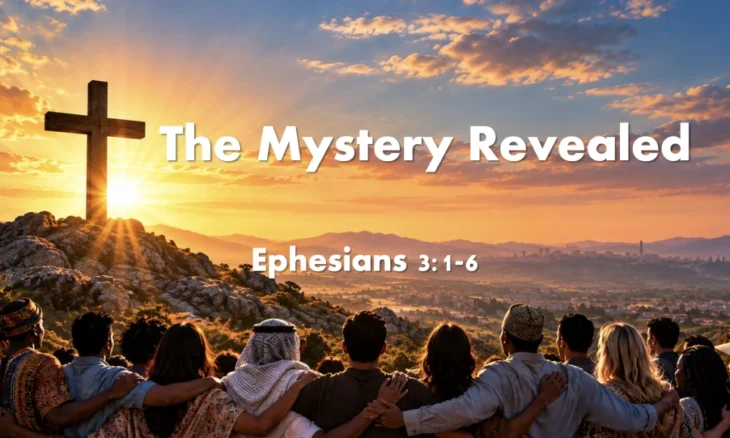
We looked at this last week: Imagine a large group of people standing in a circle around a cross. Some are standing close to one another. Others are on opposite sides of the circle. They come from different countries. They speak different languages. They have different customs and traditions. Now imagine that everyone begins walking toward the cross. Something interesting happens. As each person moves closer to the cross, the distance between the people becomes smaller.
They are not moving toward one another directly. They are moving toward Christ. But as they move toward Christ, they also move closer to one another. That is a picture of what Paul is describing. Our unity does not come from abandoning our differences. It comes from our common relationship with Jesus Christ. And the closer we follow him, the more those relationships ought to reflect his love.
For centuries, God’s people waited for the fulfillment of his promises. They knew that God had chosen Abraham. They knew that God had promised a Messiah. They knew that God’s salvation would someday reach the nations. But they did not fully understand what God intended to accomplish. Then Jesus came. He lived among us. He died on the cross. He rose from the dead. And through him, God began creating a new humanity.
People who had once been separated by hostility and prejudice were brought together. People who had been strangers became members of the same family. People who had been excluded became fellow heirs of God’s promises. And Paul says: This is the mystery that has now been revealed. But there is something else we need to understand. The mystery has been revealed, but God’s work is not finished. God is still calling people from every nation into his family.
He is still breaking down barriers. He is still reconciling people through Jesus Christ. And he is still calling his church to demonstrate what that reconciliation looks like. That brings us back home to Forest Meadow. An older congregation. Not as large as we once were. Don’t have all the resources we might wish we had. But look at what God has placed around us.
We are surrounded by people from the nations of the world. And on this very campus, believers from several of those nations gather to worship the same Lord Jesus Christ. I do not believe we should view that simply as a convenient arrangement. I believe we should recognize it as an extraordinary opportunity. God has given us the opportunity to participate in something much larger than the future of one congregation.
He has given us the opportunity to demonstrate the mystery Paul describes in Ephesians 3. One Lord. One gospel. One body. Many peoples. And perhaps the most important question we can ask ourselves is this: If Christ has made us one, what would it look like for us to live as one? We cannot answer that question simply by putting a statement about unity on our website.
We answer it through our relationships. Through our hospitality. Through our willingness to listen and learn. Through our prayers for one another. And through our commitment to share the love of Christ with our neighbors. Because the mystery is no longer hidden. God has revealed it. And now he calls us to live it. Amen.